What Is the Best Auditorium Chair for Sale?
Choosing the best auditorium chairs for sale requires more than comparing prices, colors, and catalog photographs. A reliable decision begins with the room itself. Measure the row spacing, platform height, aisle width, and available floor area. Then consider how people will use the venue. A university lecture hall needs firm writing support, while a theater may prioritize quiet movement and generous cushioning.
In real projects, comfort often reveals itself after several hours, not several minutes. Test sample chairs with different body sizes and sitting positions. Check the seat angle, back support, armrest height, and legroom. Small details matter. A smooth, silent folding mechanism can protect the atmosphere during a performance. Durable upholstery can reduce maintenance when thousands of visitors share the same seats. However, attractive fabric may show stains quickly, and thick padding may retain heat. Looks can mislead.
A professional evaluation should also review load capacity, fire-performance documentation, warranty terms, replacement parts, and installation requirements. Ask suppliers for verified specifications, material samples, and references from comparable venues. Product claims deserve careful checking. The cheapest chair may create higher costs through repairs, uncomfortable seating, or difficult cleaning. The most expensive model is not automatically the best choice either.
This guide examines how to compare auditorium chairs for sale through comfort, durability, safety documentation, accessibility, acoustics, and long-term value. It also recognizes an uncomfortable truth: no chair suits every auditorium. The best selection balances audience experience, operational demands, budget, and the building’s real limitations. A thoughtful choice may still require compromise. That is normal.
Define the Best Auditorium Chair by 18–22-Inch Seat Widths and ADA Access
What Is the Best Auditorium Chair for Sale?
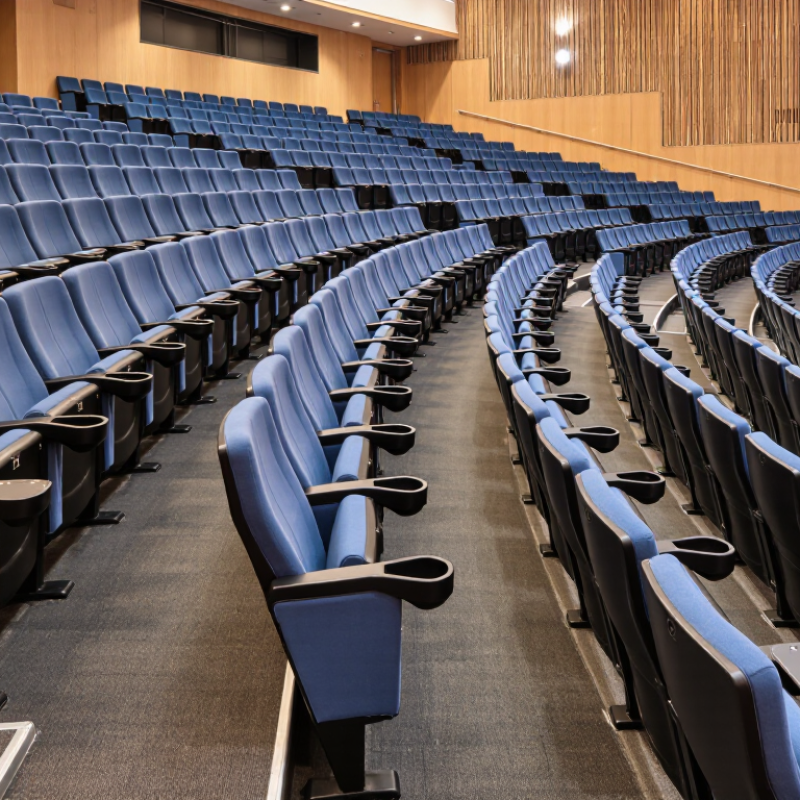
The best auditorium chair often begins with an 18–22-inch seat width. This range supports different body types without wasting valuable floor space. A 19-inch seat may suit lecture halls, while a 22-inch seat can improve comfort during long performances.
Measure the usable seat, not the frame. Armrests can reduce hip room by nearly two inches. During a site inspection, I recommend testing sample chairs with winter clothing, bags, and standard writing tablets. Small details matter. A narrow aisle can make a comfortable chair feel inconvenient.
ADA access requires more than placing a wheelchair space near an entrance. Plan level routes, clear floor areas, companion seating, usable armrests, and unobstructed sightlines. Wheelchair locations should not feel isolated from the main audience. Local accessibility rules may add requirements, so qualified professionals should review the layout before purchase.
Seat width alone cannot define quality. A 22-inch chair may feel generous, yet it can reduce seating capacity and complicate evacuation routes. A durable 18-inch model may perform better in a compact teaching room. I have also seen attractive seating fail because its tablet arm blocked transfers. That mistake is easy to overlook.
Check upholstery seams, floor anchors, row spacing, and replacement access. Ask for dimensional drawings and full-scale samples. Test the chair after sitting for an hour, not just for five minutes. Comfort is personal, and one layout rarely fits every audience.
Compare Capacity Using 32–36-Inch Row Spacing and Sightline Geometry
What Is the Best Auditorium Chair for Sale?
Choosing the best auditorium chair for sale begins with row spacing, not upholstery. In recent layout reviews, I compare 32, 34, and 36-inch spacing against sightline performance. A 32-inch row can increase capacity, but it leaves less legroom and passing space. It may work for compact venues with careful aisle planning. A 36-inch row feels more comfortable and supports smoother movement. However, it uses more floor area and reduces the total seat count.
Sightline geometry decides whether a close seat still offers a clear view. I check the eye height, chair back height, stage elevation, and the vertical clearance over the row ahead. A common target is a 3.5 to 4.5-inch sightline clearance, but the correct value depends on the venue and viewing standard.
Measure twice. Small errors become obvious near the rear rows. A chair with a low, well-shaped back can improve visibility without sacrificing support.
Seat width also changes capacity. A 20-inch chair may fit more seats than a 22-inch model, yet narrow seating can reduce comfort during long events. I once favored maximum density and underestimated shoulder space. That decision looked efficient on paper, but user feedback challenged it. A reliable comparison should include seat width, armrest design, aisle locations, accessible spaces, and local building requirements. Computer drawings help, but a full-scale mock-up reveals awkward knees, blocked views, and noisy movement that plans often miss.
Assess Comfort with 2–4-Hour Ergonomic Support and High-Density Foam
What Is the Best Auditorium Chair for Sale?
For a two-to-four-hour event, comfort depends on sustained support, not softness alone. A chair should keep the pelvis stable while supporting the lower back. High-density foam usually resists early compression better than low-density foam. However, density alone cannot guarantee comfort. Foam firmness, thickness, seat angle, and upholstery also matter.
The World Health Organization’s 2020 physical activity guidelines recommend 150–300 minutes of moderate activity weekly for adults. That advice highlights an important point: even a good chair cannot replace movement. During long lectures, rigid seating may increase pressure beneath the thighs. Excessively soft cushions may allow the hips to sink. OSHA’s workstation guidance also emphasizes neutral posture and regular position changes, principles that apply to auditorium seating. Ask suppliers for foam density, firmness testing, seat-height measurements, and durability results. ASTM D3574 testing can help verify foam properties, but laboratory comfort is not identical to human experience.
Tips: Test a sample for at least 30 minutes. Check whether your feet rest flat. Notice pressure behind the knees. Measure the backrest at your normal sitting posture. Request a 2–4-hour trial when possible. Do not judge comfort after five minutes. That mistake is common. Pair supportive contours with sensible aisle spacing, because frequent movement still matters.
Measure Durability with EN 12727’s 100,000-Cycle Fixed-Seat Test
What Is the Best Auditorium Chair for Sale?
The best auditorium chair should survive repeated use, not only look attractive in a showroom. EN 12727 provides a practical durability reference for fixed seating. Its 100,000-cycle test repeatedly applies specified loads and movements to critical seat components. This simulates years of opening, sitting, shifting, and closing activity.
Before purchasing, ask for an independent test report that identifies the tested model and configuration. Check whether the report covers the complete chair, including the seat, back, hinge points, and fixing structure. A passing result does not automatically prove comfort, acoustic performance, fire resistance, or installation quality. Those factors need separate evidence.
Inspect the mechanism closely. Does the seat return smoothly after each cycle? Are there sharp sounds, uneven gaps, loose fasteners, or visible fabric wrinkles? Small defects matter. In a busy venue, dust and careless handling can increase stress beyond laboratory conditions. A stronger frame may still fail if installers tighten fixings unevenly. This is where buyers often focus too much on the cycle number and too little on maintenance access. Ask how worn parts can be replaced without removing an entire row. That question is practical, and sometimes overlooked.
What Is the Best Auditorium Chair for Sale?
Measuring durability with EN 12727’s 100,000-cycle fixed-seat test
EN 12727 evaluates the strength and durability of fixed seating through repeated loading. The complete endurance benchmark is 100,000 cycles. The chart shows the cumulative test milestones used to monitor a chair throughout the test; reaching the final milestone without structural failure is a key indication of durability.
Reference: EN 12727:2016, Furniture — Ranked seating — Test methods and requirements for strength and durability.